

The Science of Meaning, Curiosity, and the Child You Left Behind
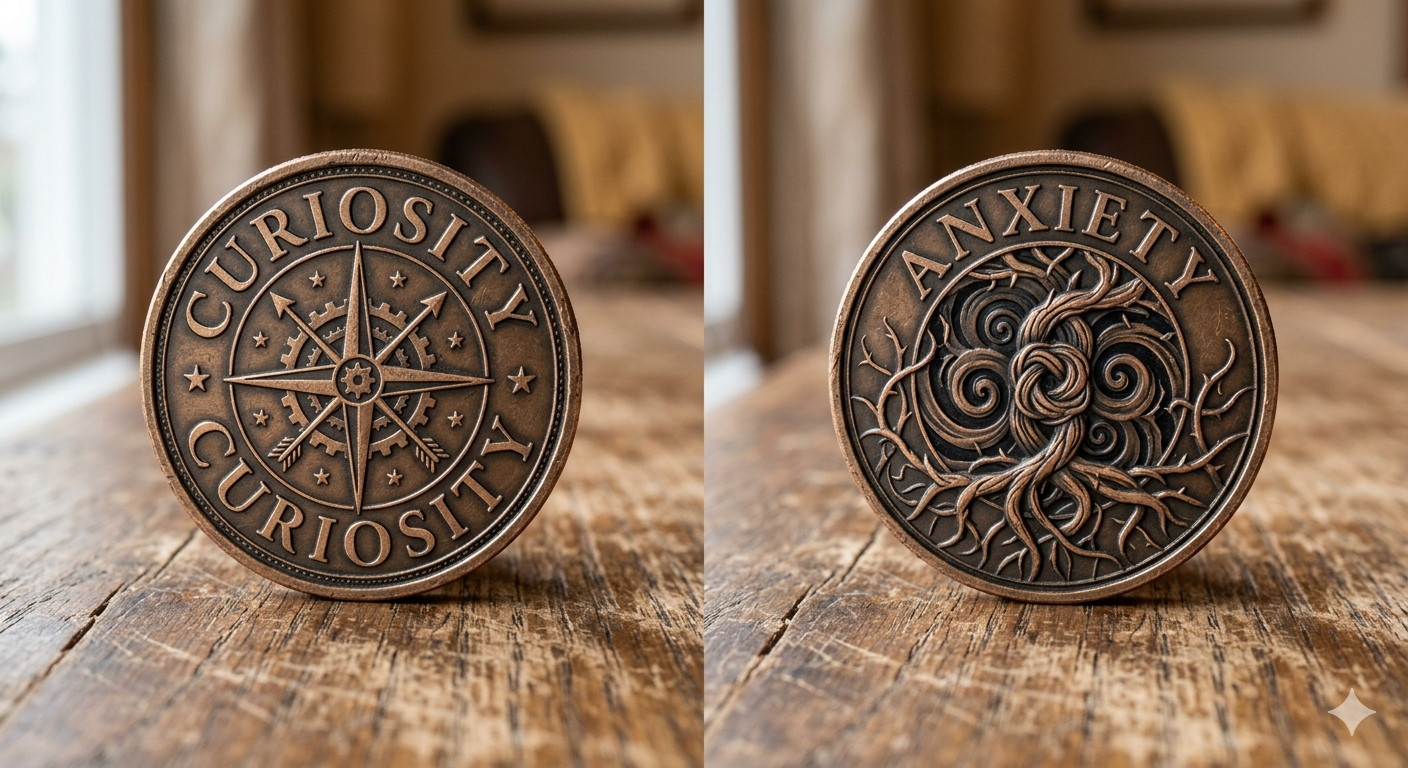
What if your anxiety isn't broken wiring?
What if it's a message?
Not a comfortable question. But an important one. Because the science - from Viktor Frankl's concentration camp observations to the 2024 neuroscience labs at the University of Hertfordshire - points in the same quiet, radical direction:
A significant proportion of the anxiety living in modern adults is not a chemical malfunction. It is an existential signal. A gap between the life being lived and the life that longs to be lived.
And the three most powerful tools for closing that gap aren't found in a prescription bottle.
They are meaning, curiosity, and the extraordinary psychological resource you were told to grow out of - your inner child.
Follow the science. It goes somewhere remarkable.
The Question Nobody Asks in a Waiting Room
When was the last time someone asked you not "how is your anxiety?" but “does your life feel meaningful?”
Probably never. Because the dominant cultural script has classified anxiety as a neurochemical disorder - something happening to the brain, best corrected by adjusting its chemistry. And while that framework has helped many people, it has also obscured something that Viennese psychiatrist Viktor Frankl documented across decades of clinical practice and one of the most extreme human experiences ever recorded.
Frankl survived four Nazi concentration camps - Auschwitz, Dachau, Kaufering, Türkheim. In the wreckage of those years, he made a clinical observation that would become one of the most cited insights in modern psychology:
The people who survived - mentally, spiritually, emotionally - were not the strongest or the youngest or the most physically resilient. They were the ones who found a reason to survive. They were the ones who still had meaning.
From that observation, Frankl built Logotherapy - a therapeutic approach anchored in the idea that the primary human drive is not pleasure (as Freud proposed) or power (as Adler argued), but meaning. And that its absence - what he called the "existential vacuum" - s the hidden driver of vast quantities of anxiety, depression, and psychological suffering that the medical system treats without ever diagnosing.
Seventy years later, peer-reviewed science has proven him right.
What the Research Found When It Went Looking
Meaning Is the Most Powerful Antidote to Existential Anxiety
A 2022 study published in PMC, using hierarchical regression analysis across multiple psychological variables, found that the presence of meaning in life was the single most significant predictor of lower anxiety about death and existence - outperforming psychological hardiness, social support, and every other variable measured.
Not coping mechanisms. Not medication management. Not cognitive restructuring.
Meaning
The researchers concluded with unusual directness: “the presence of meaning is the most crucial antidote to avoid death anxiety in all individuals.”
A 2021 existential positive psychology model, built on COVID-19 data when existential anxiety was globally measurable, proposed the precise mechanism:
- Suffering and uncertainty expose the existential questions we usually suppress
- Existential anxiety impairs the ability to make meaning - locking people in a feedback loop
- The primary pathway out of that loop, back toward flourishing - is actively cultivating meaning
And here is where it gets important: meaning, in this framework, is not discovered passively. It is not waiting somewhere for you to stumble upon it. It is made through the choices you take, the experiences you enter, the relationships you invest in, and the attitude you consciously choose toward the things you cannot change.
This is not philosophy dressed as science. It is science, peer-reviewed, institutionally validated, and measurable pointing directly to the question:
What are you doing today to make your life feel meaningful?

The Curiosity Revelation
Here is where the research takes a turn most people don't expect.
Because the science doesn't just tell us that meaning matters. It tells us how meaning is most often found and the answer is one of the most underrated psychological capacities available to every human being alive:
Curiosity.
A landmark 2024 study published in PMC, surveying 484 adults, tested the relationship between curiosity behaviors, meaning, and mental health outcomes directly. Its findings were decisive:
Curiosity behaviors are directly related to meaning in life - both directly and through the mediating effects of flourishing and cognitive reappraisal. Low curiosity is a reliable predictor of depression symptoms and anticipated anxiety.
In other words: curious people are more likely to find meaning. And more likely to feel well.
But Frontiers in Human Neuroscience (2024) went deeper, into the neural architecture of why. Curiosity and anxiety, it turns out, operate in competing systems within the same neural circuits. Curiosity activates the hippocampus and anterior cingulate cortex through what researchers call a PACE cycle: Prediction, Appraisal, Curiosity, Exploration - a loop that closes uncertainty gaps and generates reward signals.
Anxiety does the opposite. It opens uncertainty gaps, amplifies threat signals, and triggers behavioral inhibition, the neural system that says stop, don't move, danger ahead.
Here is the extraordinary clinical implication:
You cannot be simultaneously genuinely curious and deeply anxious about the same thing.
Curiosity transforms uncertainty - the core trigger of anxiety - from a threat into an invitation. Not metaphorically. Neurologically.
And now the research gets even more interesting. Because the University of Hertfordshire's 2024 study on curiosity and mental health found that not all curiosity is equal:
| Type of Curiosity | Effect on Mental Health |
|---|---|
| Joyous Exploration — wonder-driven, delight in the new | Inversely related to depression. Actively protective |
| Stretching — pushing beyond comfort zones | Growth-promoting. Inversely related to depression |
| Deprivation Sensitivity — anxious need to fill knowledge gaps | Positively associated with anxiety and stress |
The curiosity that heals is joyous. Wonder-led. Exploratory for the sheer aliveness of exploring.
The curiosity that harms is anxious, driven by the fear of not knowing enough, of being caught unaware, of falling behind.
And here is the thread that connects the neuroscience to the lived experience: joyous, wonder-driven curiosity is the native language of one specific part of the human psyche. The part most adults have systematically silenced.
Their inner child.
The Child You Were Told to Leave Behind
There is a story modern culture tells about growing up.
It goes like this: maturity is a process of leaving childhood behind. Seriousness replaces wonder. Certainty replaces curiosity. Productivity replaces play. And the adult who retains childlike qualities is not quite finished becoming who they should be.
Cambridge University Press published a direct challenge to this story in 2024 "The Myth of Growing Up: How Childlike Traits Benefit Adults". Its argument, rooted in psychological research, is that the qualities most associated with childhood - questioning, playing, imagining, expressing openness to uncertainty - do not hinder adult functioning. They enhance it across every measured domain: cognitively, emotionally, socially, and neurologically.
The peer-reviewed clinical data is equally clear.
A 2018 study published in PMC, interviewing 20 adults across a wide age range, found that accessing childhood experience and inner child awareness provides useful life lessons in four key domains: the capacity for relationship, the healing power of play, emotional resilience, and intergenerational connection. The researchers concluded that inner child experiences “can help us to adapt across the life span” contributing to mental, social, and existential dimensions of health.
A companion study of adults aged 70-91 found that the inner child remains an active, necessary dimension of wellbeing across the entire human lifespan, with dimensions including feeling safe, creative, and capable of wonder mapping directly onto the World Health Organization's definitions of holistic health.
And the most recent clinical evidence is the sharpest. A 2025 peer-reviewed study published in Regression Journal tested inner child integration techniques on adults with unresolved adverse experiences. After just four to eight sessions, results confirmed "significant improvement in wellbeing, anxiety, depression, and insomnia severity scores" - with positive effects compounding with longer intervention duration.
The inner child is not a metaphor. It is a clinical resource.

Why Play Is Not the Opposite of Seriousness
There is one more piece of science that changes everything - and it lives in the neurology of play.
A 2025 study in PMC - “Playful Brains: A Possible Neurobiological Pathway to Cognitive Enhancement” mapped precisely what happens in the adult brain during social play. Playfulness activates the locus coeruleus-noradrenergic system, a neural circuit governing attention, memory consolidation, and cognitive flexibility. The collaborative, safe environment of playful exploration transforms uncertainty - the raw material of anxiety into engaging, rewarding neural experience.
The same neural uncertainty that feeds anxiety, when met with playfulness, becomes the source of learning, connection, and joy.
The National Institute for Play documents the downstream effects: “Regular social, physical, and mental playful engagement improves cognitive flexibility and memory. Playful activities improve mental wellbeing, which has been linked to better cognitive outcomes” including reduced rates of memory decline and lowered dementia risk in aging adults.
Play is not the opposite of seriousness. It is the source of the psychological resilience that makes serious work sustainable.
The Three Questions That Change Everything
The research across Frankl's Logotherapy, the PMC curiosity studies, the Cambridge inner child analysis, the Frontiers in Human Neuroscience neuroimaging, and the clinical inner child integration trials converges on three questions. Not as philosophy. As therapeutic practice.
1. Does my life feel meaningful - and if not, what experience, action, or relationship would make it feel more so?
This is not a journaling prompt. It is the primary clinical intervention for existential anxiety, validated across decades of Logotherapy research and modern positive psychology.
2. Where am I meeting uncertainty with dread - and what would it feel like to meet it with curiosity instead?
This is not a mindset shift. It is a neurological rerouting, using the same circuits that generate anxiety to generate exploratory reward instead.
3. When did I last feel genuinely alive - light, present, delighted, unguarded?
The answer to that question is not a memory. It is a map. It points back to the inner child — and forward to the daily practice of reclaiming what was never actually lost.
The Stereotype This Breaks Wide Open
The stereotype: the composed, productive, emotionally contained adult is the aspirational norm.
The science: that adult is running on a depleted system. Suppressed curiosity. Meaning-starved. Play-deprived. Inner child silenced. And slowly, quietly, accumulating the existential anxiety that is the inevitable consequence of a life lived at the surface of itself.
| The Old Adulthood | The Whole Adulthood |
|---|---|
| Anxiety is a brain disorder | Anxiety is often a meaning signal |
| Curiosity is a personality trait | Curiosity is a trainable anti-anxiety practice |
| Growing up means leaving play behind | Play is neurologically protective at every age |
| The inner child is sentimental | Inner child integration is clinically validated |
| Meaning is found | Meaning is made — daily, actively, deliberately |
The fully realized adult is not someone who has conquered their childhood. They are someone who has integrated it, bringing the child's wonder into the adult's wisdom, the child's curiosity into the adult's competence, and the child's aliveness into the adult's purpose.
Where Lifed Lives in This Science
Every program on Lifed - every breathwork session, every somatic practice, every yoga therapy experience, every recovery program led by a certified Healthmate is, in the language of this research, a meaning-making event.
It is not content. It is not a subscription. It is not a tracker counting your steps.
It is a curated, real-world experience designed to take you from the surface of your life to its depth - from performance to presence, from anxiety to aliveness, from the depleted adult running on empty to the whole human being who woke up curious this morning.
SMALL Habits - the daily micro-practices at the heart of Lifed's ecosystem are designed precisely for the continuity challenge. Because the research is clear: meaning, curiosity, and inner child aliveness are not accessed once in a retreat and then stored. They require daily practice. Ten to fifteen minutes of the right kind of engagement - breathwork, movement, somatic attention, creative ritual maintains the neural pathways that keep the curious, meaning-oriented, wonder-alive self accessible.
And Lifed's indigenous wisdom dimension - Ayurveda, traditional breathwork, somatic practices, nature-based healing is not simply a cultural offering. These are ancient meaning-making systems: rituals that have connected human beings to purpose, presence, and the larger story they are part of for thousands of years. They are the original inner child technologies.
"We save lives in surgery. But nobody was helping people live well before they needed surgery."
- Harinekshana K.H., Founder & CPO, Lifed
Lifed is the answer to that gap - not just for the body the first research pillar addresses, but for the whole person this second pillar reveals.
Key Takeaway
Anxiety, in its most common modern form, is not a malfunction. It is a message from a life low on meaning, closed to curiosity, and disconnected from the wonder it was born with. The science of Frankl's Logotherapy, the neuroscience of curiosity, the clinical research on inner child integration, and the neuroimaging of play all point to the same prescription: not a pill, but a practice. Not a diagnosis, but a daily design. Meaning made deliberately. Curiosity cultivated joyously. The child inside the adult - not silenced, but welcomed home.
Ready to meet the whole version of yourself?
Explore Programs That Go Beyond the Surface →


Comments (0)
Be the first to respond. Comments are read by the LIFED team.